Know Before You Go
This module is for polling places using the , which doesn’t match the equipment you chose. Change your equipment or continue below.
Welcome back. We picked up where you left off.
-
GENERAL INFORMATION
GENERAL INFORMATION
General Primary: March 21, 2028
General Election: November 7, 2028
Consolidated Primary: February 27, 2029
Consolidated Election: April 3, 2029
In the primary elections, meaning the General Primary Election and Consolidated Primary Election, nominees are chosen for offices to be filled during the General Election and Consolidated Election, respectively. Voters will also elect certain party officers in the Primary Election.
To participate in a party primary, the voter must declare their party affiliation to the Election Judges. A qualified voter receives only the ballot associated with the party of their choice. The voter may declare affiliation with any party regardless of how they voted in past elections.
Nonpartisan candidates and referenda may also appear on the ballot. A voter does not declare party affiliation when voting for nonpartisan candidates or on referenda only. Candidates and referenda will appear on the appropriate party primary ballots as well as on separate ballots for voters not wanting to vote in the partisan elections. Since precinct boundaries do not necessarily correspond to local governmental unit boundaries, all voters voting a primary ballot may not be voting on referenda.
The Election Authority codes each voter in the precinct to identify which offices and referenda the voter is entitled to vote. The declared party affiliation of the voter and/or the voter’s code will determine the type of ballot (ballot style) the voter should receive. The voter may only vote the contests for which the voter is qualified.
From the manual, page 4
-
2028: Offices Nominated at the Primary and Elected at the General Election 10 ILCS 5/2A-1.2(a)
2028: Offices Nominated at the Primary and Elected at the General Election 10 ILCS 5/2A-1.2(a)
- President and Vice President of the United States (Presidential Preference Primary)
- United States Senator
- Representatives in Congress: All Districts
- State Senators (4-year terms):
- Districts 1, 3, 4, 6, 7, 9, 10, 12, 13, 15, 16, 18, 19, 21, 22, 24, 25, 27, 28, 30, 31, 33, 34, 36, 37, 39, 40, 42, 43, 45, 46, 48, 49, 51, 52, 54, 55, 57, 58
- Representatives in the General Assembly: All Districts
- Judges:
- Supreme Court Vacancies
- Appellate Court Vacancies
- Circuit Court Vacancies
- Resident Circuit Court Vacancies
- Subcircuit Vacancies
- All judges seeking retention will appear on the ballot at the General Election, and additional judgeships if required.
- County Circuit Clerks
- State’s Attorneys
- County Coroners
- County Recorders of Deeds (in counties over 60,000 population)
- County Auditors (in counties of 75,000–3,000,000 population)
- Members of Board of Review (in counties with elected Boards, including Cook Co.)
- County Commissioners (not under township organization) or County Board Members
- Sanitary District Commissioners and Trustees
- Regional Superintendent of Schools (vacancies)
From the manual, page 4
-
2028: Offices Elected at the Primary 10 ILCS 5/2A-1.2(b)
2028: Offices Elected at the Primary 10 ILCS 5/2A-1.2(b)
- Delegates and Alternate Delegates to National Nominating Conventions
- Ward Committeepersons (City of Chicago)
- Precinct Committeepersons (counties outside Cook where elected to two-year terms)
From the manual, page 4
-
2029: Consolidated Primary and Consolidated (General) Election
2029: Consolidated Primary and Consolidated (General) Election
Established Political Parties – Officers to Be Nominated at the Primary:
- MUNICIPAL (pop. over 5,000 and/or Special Charter): 10 ILCS 5/2A-1.2(c)
- Mayor or President
- Clerk
- Treasurer
- Alderperson or Trustee
- MUNICIPALITIES OF 5,000 OR LESS POPULATION
- May be determined by ordinance that political parties shall nominate candidates for municipal offices by primary (10 ILCS 5/7-1(b)).
- Villages that nominated and elected candidates for president and trustees in partisan elections prior to January 1, 1992, may continue to hold partisan elections without conducting a referendum (65 ILCS 5/3.1-25-20).
- TOWNSHIP (only where the township central committee has approved a primary) (60 ILCS 1/45-5, 45-55)
- Supervisor, Clerk, Assessor or Multi-Township Assessor, Highway Commissioner, Collector (if elected), and Trustees
Nonpartisan – Officers to Be Nominated or Elected at the Consolidated Primary:
- MUNICIPAL – Council-Manager Form (Council Members at-large and from districts)
- Mayor or President
- Clerk
- Treasurer (Council-Manager form only)
- Council Members, Trustees, or Alderpersons
- NOTE: A village may conduct a nonpartisan primary by referendum. (Municipalities incorporated after May 13, 1993, are nonpartisan unless they adopt the partisan format.) (65 ILCS 5/3.1-25-60)
- MUNICIPAL – City of Chicago: Alderperson, if required due to a vacancy (65 ILCS 5/3.1-10-51, 20/21-22)
Consolidated (General) Election – Established Political Parties, Independent, and New Political Parties – Officers to Be Elected:
- MUNICIPAL – including Special Charter: 10 ILCS 5/2A-1.2(c)(1)
- Mayor or President
- Clerk
- Treasurer
- Alderperson or Trustee
- TOWNSHIP – Supervisor, Clerk, Assessor or Multi-Township Assessor, Highway Commissioner, Collector (if elected), and Trustees
Nonpartisan – Officers to Be Elected:
- MUNICIPAL – Council-Manager form (council members at-large and from districts), Commission form (10 ILCS 5/2A-29): Mayor or President, Clerk, Treasurer (Council-Manager only), Council Members, Commissioners, Trustees, or Alderpersons
- MUNICIPAL – City of Chicago: Alderperson run-off for an unexpired term created by a vacancy, if required (65 ILCS 5/3.1-10-51(b), 20/21-22 and 21-25)
- PARK DISTRICT – Commissioners, Trustees (10 ILCS 5/2A-38)
- PUBLIC LIBRARY DISTRICT – Trustees (10 ILCS 5/2A-1.2(c)(5))
- TOWNSHIP AND MUNICIPAL LIBRARY – Trustees (10 ILCS 5/2A-1.2(c)(5)(7))
- REGIONAL BOARD OF SCHOOL TRUSTEES – Trustees (10 ILCS 5/2A-50)
- SCHOOL DISTRICT – Board Members (including districts under article 33; however, those districts are exempt from the non-primary provision of Section 2A-1.2(c)(12)), School Directors (10 ILCS 5/2A-1.2(c)(9)(12))
- SCHOOL DISTRICT – Special Charter – Inspectors, Board Members (10 ILCS 5/2A-49)
- TOWNSHIP TRUSTEES OF SCHOOLS (Cook County only) (10 ILCS 5/2A-51)
- COMMUNITY COLLEGE DISTRICT – Trustees (10 ILCS 5/2A-1.2(c)(13))
- TOWNSHIP LAND COMMISSIONERS (in counties under 220,000 population) (105 ILCS 5/15-24, 10 ILCS 5/2A-1.2(c)(17))
- FIRE PROTECTION DISTRICT – Trustees (10 ILCS 5/2A-1.2(c)(14))
- ROAD DISTRICT – Clerk and Commissioners
- PUBLIC WATER DISTRICT – Trustees (70 ILCS 3705/4.2, 10 ILCS 5/2A-1.2(c)(17))
- FOX METRO WATER RECLAMATION DISTRICT – Trustees
- FOX WATERWAY AGENCY – Directors (10 ILCS 5/2A-1.2(c)(10))
- FOREST PRESERVE DISTRICT – Commissioners (10 ILCS 5/2A-1.2(c)(11))
- SPRINGFIELD METROPOLITAN EXPOSITION AND AUDITORIUM AUTHORITY – Commissioners (10 ILCS 5/2A-1.2(c)(15))
- OTHER SPECIAL PURPOSE DISTRICTS
From the manual, page 5
- MUNICIPAL (pop. over 5,000 and/or Special Charter): 10 ILCS 5/2A-1.2(c)
-
TERMS TO KNOW
Step 1
Affidavit – A written statement confirmed by oath or affirmation for use as evidence in court.
From the manual, page 6
-
TERMS TO KNOW
Step 2
Application to Vote – An application to vote is the form on which a voter enters the necessary information needed to receive a ballot. The voter signs the application and the Judges must verify the information given matches the available records. If the application and record match, the voter is entitled to a ballot.
From the manual, page 6
-
TERMS TO KNOW
Step 3
Ballot Box – The ballot box (or ballot bin) is a large container where ballots are deposited and kept after a voter has successfully voted their ballot and fed it through the tabulator. Ballots are stored in the sealed ballot box until voting is finished and closing procedures require the ballot box be opened.
From the manual, page 6
-
TERMS TO KNOW
Step 4
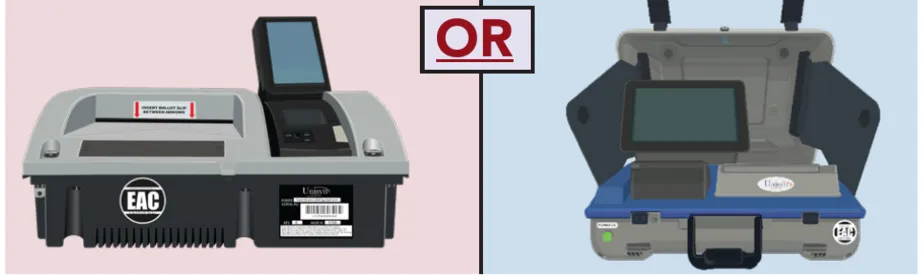
Ballot Scanner/Tabulator – “Ballot scanner” and “ballot tabulator” (or just tabulator) may be used interchangeably to refer to either the OVO or FVS machines, which are placed on top of the ballot box. Voters deposit their voted ballots into these scanners/tabulators so that the machine may scan, count, and tabulate the ballots.
From the manual, page 6
-
TERMS TO KNOW
Step 5
Ballot Style – The term “ballot style” is interchangeable with “ballot type,” “ballot code,” or “ballot configuration.” There will be multiple ballot styles in precincts in which voters do not vote the same offices or propositions.
From the manual, page 6
-
TERMS TO KNOW
Step 6
Campaign Free Zone – A Campaign Free Zone prohibits advertising pertaining to any candidate, proposition, or political party. No one is to wear a campaign button, display political literature, or engage in any political discussion within the restricted area. The Campaign Free Zone consists of the polling room and the distance within 100 horizontal feet of any such room. Any person who violates this section is in contempt of court.
From the manual, page 6
-
TERMS TO KNOW
Step 7
Challenge – A challenge is an assertion that a voter is not qualified to vote at a specific polling location. An Election Judge, another voter, or a poll watcher may challenge a prospective voter’s right to receive a ballot.
From the manual, page 6
-
TERMS TO KNOW
Step 8
Election Authority – The appropriate Election Authority (i.e., the County Clerk or the Board of Election Commissioners) conducts all elections. Contact your Election Authority if you have questions or problems on Election Day.
From the manual, page 6
-
TERMS TO KNOW
Step 9
Electioneering – Electioneering is working for, against, or in the interest of a candidate, party, or proposition. Electioneering is prohibited within the Campaign Free Zone.
From the manual, page 6
-
TERMS TO KNOW
Step 10
Overvoted Ballot/Contest – An overvoted ballot is a ballot that has one or more overvoted contests. An overvoted contest is a race where the voter voted for more candidates than allowable.
From the manual, page 6
-
TERMS TO KNOW
Step 11
Proposition – A proposal to enact new laws or constitutional amendments or repeal existing laws or constitutional amendments that are placed on the ballot for approval or rejection by the electorate.
From the manual, page 6
-
TERMS TO KNOW
Step 12
Referendum – A proposal to repeal a law that was previously enacted by the legislature and is placed on the ballot by citizen petition.
From the manual, page 6
-
TERMS TO KNOW
Step 13
Signature Verification Record – A record of registered voters’ information including: name, address, and a copy of their signature. The Record enables Election Judges to verify the signatures and addresses of prospective voters. The Signature Verification Record can come in a few different forms; Election Authorities may use scanned signatures on a separate signature roster list, preprinted Applications to Vote, or Electronic Poll Books. Your Election Authority will explain which type of Signature Verification Record will be used in your polling place.
From the manual, page 6
-
TERMS TO KNOW
Step 14
Undervoted Ballot/Contest – An undervoted ballot is a ballot that has one or more undervoted contests. In this case, the voter has selected fewer candidates than allotted for a particular contest. A voter may undervote any contest they choose, and whatever selections they have made will still be counted.
All Election Judges are assigned a polling place to which they will report. While at the polling place, you are responsible for the proper legal conduct of the election. Election Judges serve as officers of the Circuit Court and swear or affirm to uphold the Constitution of the United States and the State of Illinois. Your responsibilities as an Election Judge are listed below.
From the manual, page 6 and 7
-
ELECTION JUDGE RESPONSIBILITIES
Step 1
EQUAL AUTHORITY – All Election Judges have equal authority and responsibility in upholding the law. The Judges shall act as a board in making decisions and the majority shall rule. However, each Judge may act alone to enforce election laws. Once selected to serve as an Election Judge, that person is obligated to serve at each election during that two-year period. If an emergency arises that prevents a Judge from serving, the Judge MUST NOTIFY THE ELECTION AUTHORITY as soon as possible.
From the manual, page 7
-
ELECTION JUDGE RESPONSIBILITIES
Step 2
WORKING HOURS – Illinois law requires that the polls be open from 6:00 a.m. until 7:00 p.m. Once the polls are open, there is no adjournment or recess until all forms are completed and the ballots have been delivered to the Election Authority. All Judges should arrive at the polls no later than 5:00 a.m. (unless otherwise designated by the Election Authority) to check the supplies and set up the polling place. After the polls close, all Judges must remain until all forms, certificates, and affidavits are completed and signed, and all necessary election materials are packaged for return to the Election Authority.
From the manual, page 7
-
ELECTION JUDGE RESPONSIBILITIES
Step 3
HANDLE AND MONITOR ELECTION EQUIPMENT – Only Election Judges are to handle the election materials, supplies, and ballots. Judges should also take careful measures to set up and maintain all equipment and machinery properly.
From the manual, page 7
-
ELECTION JUDGE RESPONSIBILITIES
Step 4
ROTATING POSITIONS/STATIONS – Each Judge should learn the various duties associated with each position by rotating among the stations throughout the day. Rotating stations and responsibilities will help to prevent errors and help prohibit certain types of fraudulent activity. When rotating stations, two Judges, one from each political party, must always be at the signature verification records to verify each voter’s signature and address.
From the manual, page 7
-
ELECTION JUDGE RESPONSIBILITIES
Step 5
CONTROL OF THE POLLING PLACE (AND CAMPAIGN FREE ZONE) – Election Judges are required to maintain order in the polling place throughout Election Day. All persons in the polling place or within the Campaign Free Zone must obey a lawful order of the Judges. Election Judges have the authority to evict any person who is creating a disturbance. Appropriate law enforcement officials may arrest individuals violating the law. Report all serious problems to the Election Authority.
Election Judges should have a security plan before Election Day. This includes:
- Surveillance: Observing the polling place without invading voter privacy.
- Entrances/Exits: Clearly marking all entry and exit points.
- Communication: Having a way to call for help in an emergency.
During the election, Judges should watch for suspicious behavior, such as unattended items, people asking unusual questions, or anyone paying too much attention to the building or tabulators.
REPLACEMENT JUDGES – If a Judge fails to appear to the polls, one of the remaining Judges present at the polling place should contact the Election Authority for a replacement. If the Election Authority cannot provide a replacement, the Judges present may appoint a replacement Judge.
However, a replacement Judge may not be sworn in until after 6:15 a.m. The replacement must be a registered voter who has the same political affiliation as the absent Judge. A precinct, township, or ward committeeperson, or a candidate, cannot serve as an Election Judge.
One of the Judges already present shall administer the oath to the replacement Judge. If at any time the regular appointed Judge arrives, they shall assume the duties of the replacement Judge and the replacement Judge will cease to serve. Both Judges sign the payroll sheet to record what hours they served.
WHERE IS THE POLLING PLACE THAT I HAVE BEEN ASSIGNED TO SERVE?
WHO IS MY ELECTION AUTHORITY?
From the manual, page 7 and 8
-
How do I contact my Election Authority?
How do I contact my Election Authority?
Phone: ________________________________________
E-Mail: _______________________________________________________
From the manual, page 8
-
What equipment will I be using?
What equipment will I be using?
TABULATOR: You will have one or the other. Mark which one for later reference.
Am I required to return the TM Stick after closing the polls on Election Night?
_____ YES – Ask your Election Authority for instructions regarding secure storage and transportation of the TM Stick on Election Night. Also, ask what other equipment and materials Election Judges are expected to deliver.
_____ NO – Ask your Election Authority which equipment and materials are required for the Judges to deliver after polls close on Election Night.
TOUCHSCREEN: Your polling place will use the FVT Touchscreen for voters who need assistance marking their ballot.
If using the FVT Touchscreen, will you be using the Manual Entry procedure or the Barcode Entry procedure?
_____ Manual Entry OR _____ Barcode Entry
From the manual, page 8
-
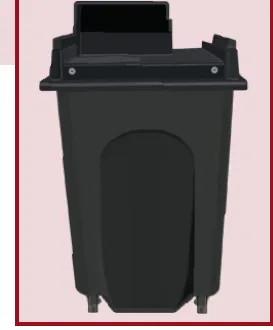
Which style of ballot box will I be using? (You will only have one style of ballot box.)
Which style of ballot box will I be using? (You will only have one style of ballot box.)
_____ Ballot Box (OVO) – Ballot box base fitted with an OVO-compatible lid.
_____ Ballot Box (FVS) – Ballot box base fitted with an FVS-compatible lid.
_____ FVS Ballot Box – Only compatible with the FVS Tabulator.
Ballot Box (OVO)
View full-size picture (opens in a new tab) Ballot Box (FVS)

View full-size picture (opens in a new tab) FVS Ballot Box

View full-size picture (opens in a new tab) From the manual, page 8
-
How many copies of each report will I need to deliver to my Election Authority?
How many copies of each report will I need to deliver to my Election Authority?
TABULATOR (highlight the Tabulator in use at your polling place: OVO / FVS):
MACHINE INFO REPORT: ______ (Save this report.)
ZERO COUNT REPORT (one per ballot style): ______ (Save this report after all Judges have signed it.)
ELECTION SUMMARY REPORT (one per precinct): ______ (Save this report after all Judges have signed the report for their assigned precinct.)
WRITE-IN REPORT: ______ (Save this report after all Judges have signed it.)
FVT TOUCHSCREEN:
OPEN REPORT: ______ (Save this report after all Judges have signed it.)
CLOSE REPORT: ______ (Save this report after all Judges have signed it.)
DID MY ELECTION AUTHORITY HAVE MY TABULATOR (AND/OR) TOUCHSCREEN PROGRAMMED TO PRINT THE REQUIRED NUMBER OF COPIES OF ANY OF THE REPORTS LISTED BELOW?
ZERO COUNT REPORT(S):
Yes _____
If yes, how many? ______
No _____
ELECTION SUMMARY REPORT(S):
Yes _____
If yes, how many? ______
No _____
NOTES:
From the manual, page 9
-
Check your understanding
Questions about equipment your polling place doesn’t use are left out.
Draft quiz: these questions haven’t been reviewed by Liberty Systems yet.
-
You’ve finished this module
You’ve worked through Know Before You Go (manual pages 4–9).

Tip: you can use the ← and → arrow keys.